
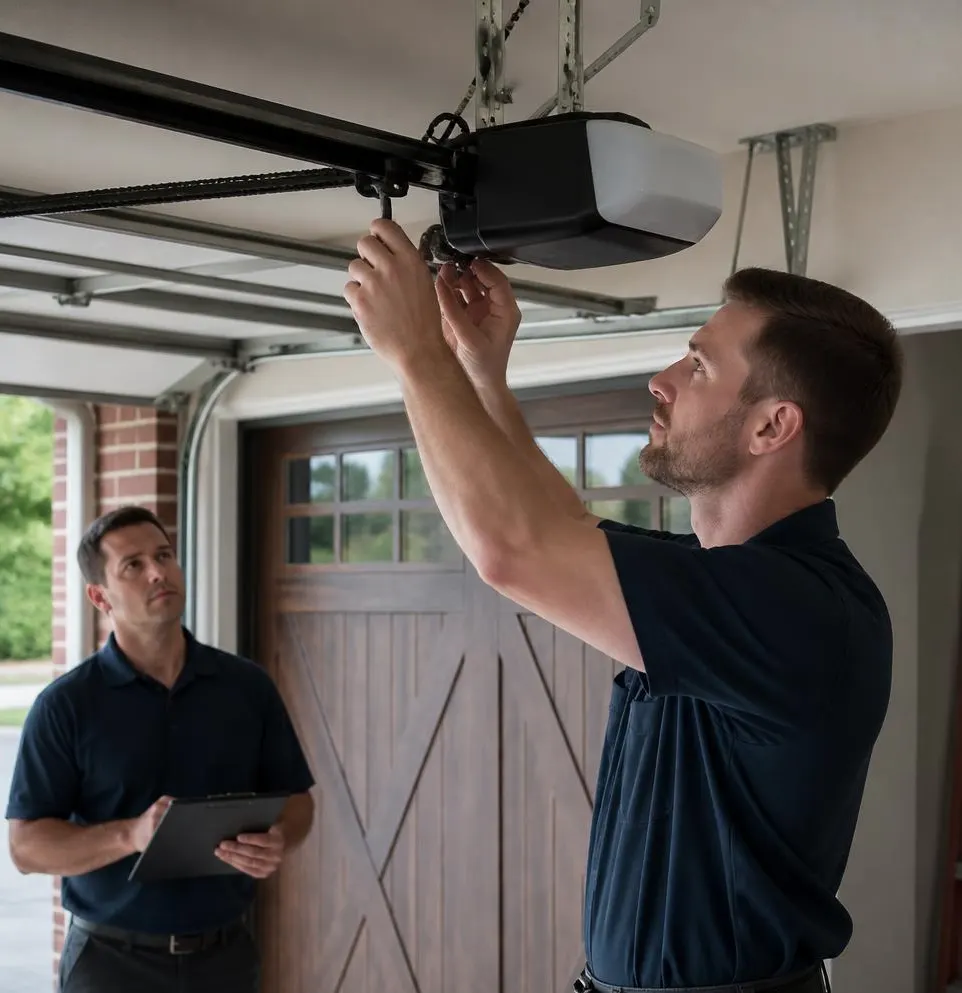
What a Service Call Usually Looks Like
A technician pulls up after a storm and finds the same thing over and over: a garage door bowed inward in the middle, tracks ripped loose from the wall studs, or panels that look fine from across the yard but are visibly caved when you get close. The homeowner usually says the same thing too — they knew the roof was rated for wind, they'd checked the windows, but nobody told them the garage door needed the same attention. By the time anyone notices, the door has already done its damage.
Why the Garage Door Is the Weakest Wall in the House
A garage door is the largest moving opening in most homes, and it's held in place by rollers, tracks, and springs rather than the kind of solid framing that holds a wall together. When wind pressure builds against a house during a storm and the garage door fails — buckles, blows in, or gets torn off its tracks — air rushes into the garage and pushes outward on the roof and walls from the inside. That internal pressure is a major reason homes lose roofs during high wind events. A door that's rated for the wind loads common in this part of Florida, and properly braced, is one of the simplest ways to keep that from happening.
Signs the Door Isn't Up to the Job
- Panels that flex or ripple noticeably when the door is pushed by hand
- Tracks fastened with light-duty brackets instead of heavier wind-rated hardware
- No horizontal or vertical bracing on the back of the panels
- A door that's visibly older than the rest of the home's storm upgrades
What Humidity and Afternoon Storms Do to a Door Over Time
Even before a named storm shows up, the regular weather here wears a door down. Daily humidity causes wood-composite panels to swell slightly and metal hardware to sweat, which speeds up rust on tracks, hinges, and spring coils. Homes closer to the coast deal with salt air on top of that, which eats through unprotected metal faster than people expect. Afternoon downpours test weatherstripping and bottom seals — if water is getting under the door during a regular summer storm, it will get in worse during a tropical system.
A Pre-Storm Checklist Worth Doing Now
- Inspect the tracks for rust, pitting, or loose lag bolts where they attach to the framing.
- Check the rollers for cracking or flat spots — worn rollers let the door rattle loose under wind pressure instead of riding smoothly.
- Test the springs by watching how the door moves when opened by hand (opener disconnected). A door that feels heavy or uneven often has a spring issue that will get worse under stress.
- Look at the weatherstripping along the bottom and sides for cracking, gaps, or flattening.
- Confirm the door has bracing — horizontal struts across the panels, especially on wider double doors, make a real difference in wind resistance.
- Check the opener's backup power if it has one, since outages are common during and after storms.
Reinforcing an Older Door Instead of Replacing It
Not every door needs to be replaced before storm season. Retrofit bracing kits can stiffen an existing door's panels, and swapping worn rollers, hinges, and track brackets for heavier-duty hardware costs far less than full replacement. That said, if the door is older, visibly weak under hand pressure, or was installed before wind-load ratings were common in this area, a full wind-rated replacement is the more reliable long-term fix rather than patching a door that's already near the end of its service life.
During and After the Storm
Avoid opening or closing the door manually in high wind — a gust can catch an open door and tear it off the track. After the storm passes, walk around and look (don't touch) for bent tracks, separated panels, or hardware pulled loose from the wall. If the opener got wet or the door won't move smoothly, don't force it; a bent track or waterlogged opener can fail suddenly under load.
When to Call Immokalee Garage Door
If an inspection turns up rust on the tracks, a door that flexes more than it should, or panels that look weak going into storm season, that's the point to call in a Garage Door Maintenance & Tune-Up before the next system forms. If a door has already taken damage — knocked off its tracks, a bent panel, or hardware torn loose — Off Track Door Repair and Garage Door Panel Replacement get it back to full strength instead of leaving a weak point on the house. For homeowners in Immokalee, Naples, Ave Maria, LaBelle, Lehigh Acres, Golden Gate, Marco Island, and Bonita Springs, now is the time to get it checked, not after the next storm watch is issued. Call Immokalee Garage Door today to schedule an inspection.